
Concrete Patio Maintenance in Macon: How to Protect Your Investment
A concrete patio or driveway in Macon, Georgia is a 25–40 year investment — but that lifespan is only achieved with the right maintenance at the right intervals. Neglected concrete in Bibb County’s climate deteriorates faster than in most Southeast regions because of the combination of high UV exposure, 47 inches of annual rainfall, and 30–40 freeze-thaw cycles per year. This guide tells you exactly what to do, when to do it, and what to watch for to get the most out of your Macon concrete.
Need Professional Concrete Maintenance in Macon?
Macon Concrete Pros provides sealing, crack repair, and resurfacing throughout Bibb County. Call (888) 376-0955.
Why Concrete Maintenance Matters More in Macon
Macon’s humid subtropical climate creates two specific maintenance challenges that homeowners in drier or cooler regions don’t face to the same degree. First, Bibb County’s 47 annual inches of rainfall provide constant moisture pressure on concrete — keeping surfaces and sub-bases wetter longer than in lower-rainfall areas, which feeds both mold and algae growth and the clay saturation that causes settling and cracking.
Second, Georgia’s UV intensity degrades concrete sealers and oxidizes exposed concrete surfaces faster than in cloudier climates. UV breakdown of the cement paste at the surface level leads to scaling and dusting within 10–15 years on unsealed concrete. Regular sealing interrupts both the UV degradation cycle and the water penetration that drives freeze-thaw damage in Macon’s winters. The result: sealed concrete in Macon can look near-new at year 25; unsealed concrete often looks tired by year 10.
Types / Options: Types of Concrete Sealers for Macon
Choosing the right sealer for Macon’s climate matters as much as applying it on schedule.
Penetrating sealers (silane/siloxane): These penetrate the concrete surface and react chemically to create water repellency without changing the surface appearance. Excellent for broom finish driveways and patios in Macon where you want protection without gloss. Penetrating sealers don’t film-build and therefore don’t peel — they simply lose effectiveness over time and need reapplication every 3–5 years.
Acrylic film-forming sealers: Create a protective film over the surface, adding mild sheen and color enhancement. Appropriate for decorative concrete — exposed aggregate, colored concrete, and broom finish patios where light enhancement is desired. Film-forming sealers require reapplication every 2–3 years in Macon’s UV environment; they can peel if applied over an already-coated surface without proper preparation.
Polyurethane sealers: The highest-performance sealer for stamped concrete in Macon. Polyurethane provides excellent UV resistance, abrasion resistance, and chemical resistance (including oil and fuel stains on driveways). Costs more than acrylic but lasts longer and provides better color retention for stamped concrete in Georgia’s sun. Requires reapplication every 3–5 years depending on traffic and sun exposure.
Practical Uses: Concrete Maintenance Calendar for Macon
- Annual (April/May): Clean all concrete surfaces with a low-pressure washer or stiff brush and mild detergent. Remove organic growth (algae, moss) that accumulates on shaded or low-drainage surfaces in Macon’s humid climate. Check for new cracks and measure existing ones to track whether they’re growing.
- Every 2–3 years (October, before freeze season): Apply concrete sealer. October is ideal in Macon — temperatures have dropped below summer peaks, freeze risk hasn’t arrived yet, and the sealer has time to cure before winter’s first freeze-thaw cycles. Clean surface thoroughly and allow to dry before sealing.
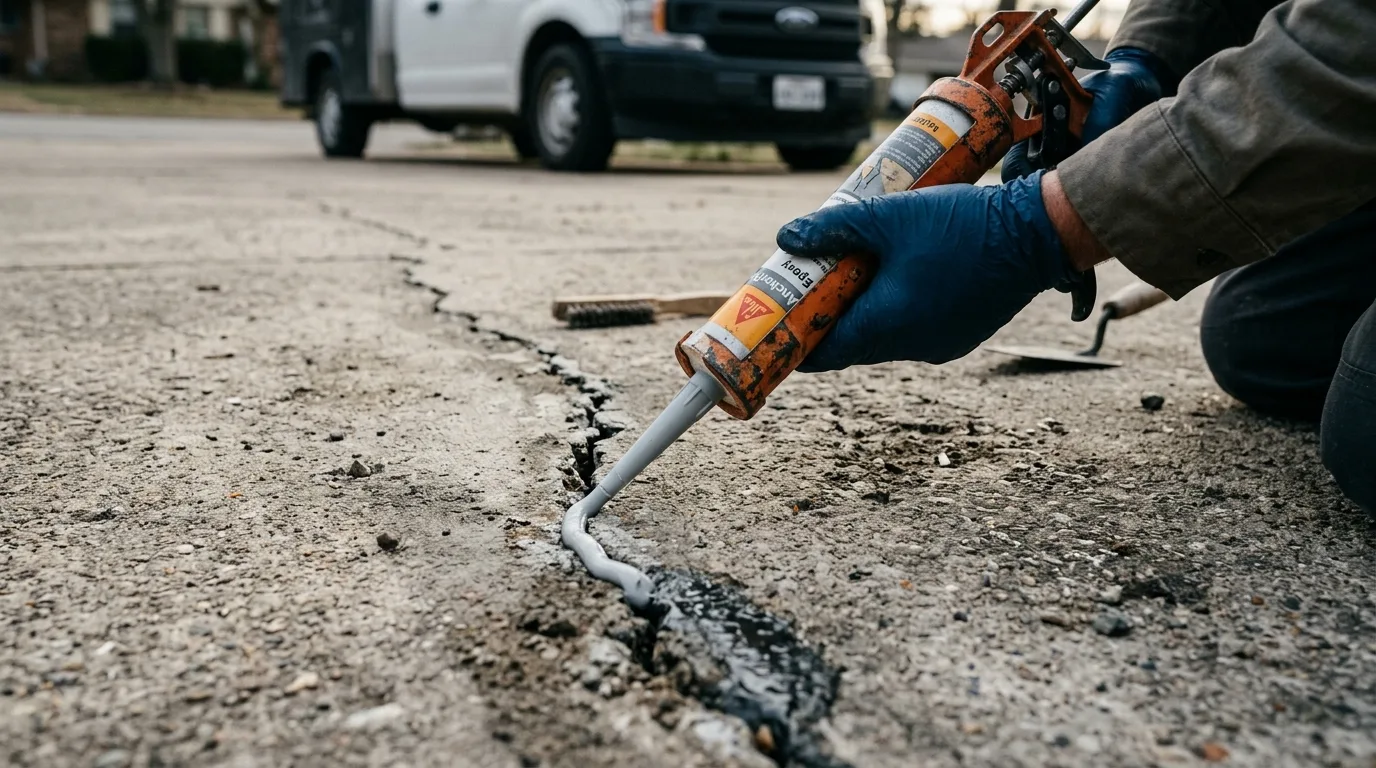
- As needed: Fill cracks promptly when they develop. Cracks wider than 1/8 inch that are allowed to open through winter freeze-thaw cycles become progressively harder to fill effectively. Early crack repair in Macon is significantly cheaper than deferred crack repair — see our concrete repair service page for what’s involved.
- Every 5–10 years: Assess whether resurfacing is appropriate. Concrete that has surface scaling, moderate staining, or light cracking that hasn’t compromised the slab structure can be resurfaced with a bonded concrete overlay, giving another 10–15 years of surface life at a fraction of replacement cost.
- After severe winter: Inspect for new freeze-thaw damage in March, after Macon’s final frost risk. The 30–40 freeze-thaw cycles from November through March are when most crack propagation occurs in Bibb County concrete. Early spring is when you catch new damage before it worsens through summer’s clay swelling cycle.
How Macon’s Climate Creates Specific Maintenance Needs
Macon’s concrete maintenance challenges are different from both Northern climates (where road salt causes concrete damage not relevant here) and warmer Southern coastal cities (where salt air affects concrete chemistry). Bibb County’s specific challenges:
Organic growth: Macon’s humidity — average relative humidity of 69% in summer — creates ideal conditions for algae, moss, and mildew on shaded or low-drainage concrete surfaces. North-facing patios in neighborhoods like Shirley Hills are particularly prone to green staining and surface slipperiness from organic growth. Annual cleaning with a dilute sodium hypochlorite solution (10% bleach, 90% water) removes existing growth; regular sealing reduces recolonization by limiting surface porosity.
Staining from Bibb County’s red clay: Iron-rich clay soil tracked across concrete creates rust-brown staining that’s difficult to remove if not cleaned promptly. Sealer significantly reduces staining by preventing clay particles from penetrating the surface pores. Rinse concrete quickly after clay soil contact during and after Macon’s wet seasons.
Expansion joint maintenance: Control joints in Macon concrete fill with debris over time, which limits their ability to accommodate thermal expansion and can cause spalling at joint edges. Annual cleaning of control joints with a stiff-bristle brush, followed by flexible polyurethane joint sealant application, maintains the joints’ function and appearance.
Professional Concrete Sealing in Macon, GA
Macon Concrete Pros provides sealing, cleaning, and maintenance services throughout Bibb County. Call (888) 376-0955.
Cost Factors
Concrete maintenance costs in Macon are modest compared to the cost of repair or replacement they prevent. Professional concrete sealing services run $0.25–$0.75 per square foot depending on sealer type and surface condition — a 600-square-foot driveway costs $150–$450 to professionally seal. DIY sealing with penetrating sealer purchased at a local supply house runs $80–$150 in materials, though proper surface preparation (cleaning, light etching if needed) is often underestimated by homeowners attempting it for the first time.
Professional crack repair for hairline to moderate cracks runs $300–$800 for a typical Macon driveway — a fraction of the cost of allowing those cracks to widen through Bibb County’s winter freeze-thaw cycles and eventually require resurfacing or replacement. See our concrete cost guide for Macon for pricing context.
Frequently Asked Questions
How often should I seal concrete in Macon, GA?
Seal stamped concrete every 2–3 years and broom finish or exposed aggregate concrete every 3–5 years in Macon’s climate. The sealing interval depends on sun exposure (south-facing concrete in Macon fades and degrades sealer faster than shaded concrete), traffic level, and the sealer type used. Penetrating sealers last longer between applications than film-forming sealers; polyurethane outlasts acrylic. October is the best month for sealing in Macon — after summer heat, before freeze season.
Can I seal my own concrete in Macon?
Yes — penetrating sealers are homeowner-friendly and forgiving of application variation. Film-forming and polyurethane sealers require more surface preparation and application precision for good results. Before sealing any previously sealed concrete, check whether the existing sealer has failed (water no longer beads on the surface); if it hasn’t failed, a new coat may not bond well. For stamped concrete with significant color value, professional sealing with a polyurethane product is recommended.
How do I remove algae from my concrete patio in Macon?
Mix 1 cup of household bleach in a gallon of water (10% solution). Apply to the affected area, let sit for 15–20 minutes, then scrub with a stiff-bristle brush and rinse with a low-pressure hose. Avoid pressure washing at high settings — pressure washing above 1,500 PSI can etch concrete surfaces and remove sealers. After cleaning, applying a penetrating sealer reduces the surface porosity that allows algae to establish. For recurring growth on heavily shaded surfaces in Macon, consider a professional cleaning service for the initial treatment.
Macon Concrete Maintenance Done Right
Call Macon Concrete Pros at (888) 376-0955 for sealing, crack repair, and resurfacing across Bibb County.
Related: